1 by 1 pix

Anatomy of a Killer Facebook Ad

Mar 29, 2019 | Knowledge

Anatomy of a Killer Facebook Ad

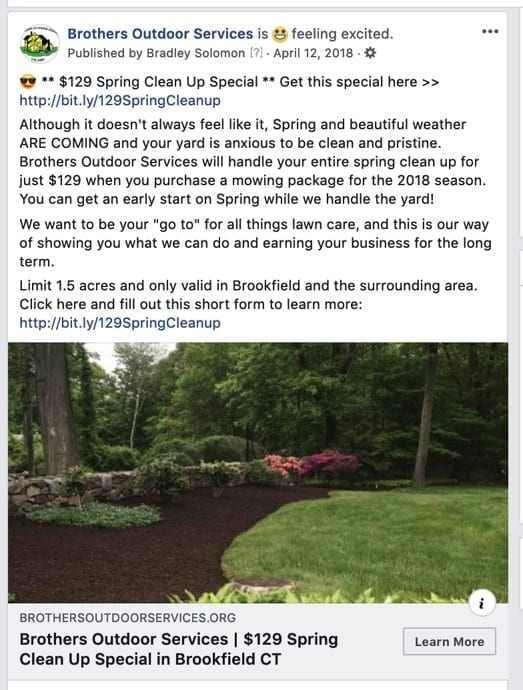
Not only do we talk the talk, but we walk the walk. Learn how we helped a lawn care company generate twenty-five new customers within one week on Facebook.

When we first start working with a client, we get to know their business as if it’s our own. Once we understand our clients’ business, we’re able to apply our digital marketing expertise to create effective campaigns that produce results.

So, what does it take to create an effective Facebook ad that generates leads

1. A great offer

The most important element to any advertisement is the quality of the offer itself. Luckily, in this case, the offer was fantastic. Only $129 for a spring cleanup is a great deal in any area, and the fact that the deal requires customers to sign up for a year’s worth of mowing makes it a great deal for the business too.

2. An eye-catching headline

Keep in mind that you have only a couple seconds to truly grab your reader’s attention… and this is especially true on Facebook. Assume your reader is not going to read all of your text… so make sure you’re quick with the offer and that you grab the reader’s attention.

3. Engaging copy

Be personable and natural in your copy, use proper punctuation, and have some fun with it!

4. A clear call to action (CTA)

It needs to be easy for the reader to understand what they should do next, and how they should do it.
5. A targeted landing page

Once a Facebook user sees your ad on Facebook and clicks on it to learn more, they should be taken directly to a page on your website that further explains the offer they just saw. You  never want to send someone who clicked on an offer to your home page – they’ll just get confused and leave.

You must make it easy for people to take advantage of your offer by placing the phone number in a prominent location, and providing a short conversion form (no more than four fields).
Grab our free guide to learn the top ways to grow your business online this year

Name(Required)
This field is hidden when viewing the form

Get Your No-Cost Digital Success Blueprint

"*" indicates required fields

This field is for validation purposes and should be left unchanged.
This field is hidden when viewing the form

Recent Blogs

How Google Decides Which Page to Show for a Search

When someone searches for something on Google, your website may have several pages that could potentially answer their question. So how does Google decide which page to show? Google doesn't simply look for the page that contains the most keywords. It considers a...

When Should You Increase Your Google Ads Budget?

Increasing your Google Ads budget can be a great way to generate more leads, but spending more money doesn't automatically mean getting better results. Before increasing your budget, it's important to understand whether your campaigns are already performing well and...

What Makes a Google Business Profile Look Trustworthy?

When someone finds your business on Google, your Google Business Profile may be one of the first things they see. Before they visit your website or contact your business, they may look at your photos, reviews, services, hours, location, and other information listed on...

What Is Impression Share and What Does It Tell You?

When you run Google Ads, it is easy to focus on clicks, impressions, and conversions. But there is another metric that can tell you how often your ads are actually competing for available searches: impression share. Impression share can help explain why your ads are...

Website Redesign vs. Website Refresh: Which Does Your Business Need?

Your website is often one of the first places potential customers go to learn about your business. If it looks outdated, loads slowly, is difficult to navigate, or no longer reflects your services, it could be costing you leads. But does your business need a complete...

When Should You Pause a Google Ads Campaign?

Running Google Ads does not mean a campaign should stay active indefinitely. Sometimes the smartest move is to pause a campaign, make changes, and restart it once there is a stronger strategy in place. At SC Digital, we don't recommend pausing a campaign simply...

What Local Businesses Should Know About Google’s Map Pack

When someone searches for a local service on Google, they are often shown a map with a small group of businesses listed underneath it. This section is known as the Google Map Pack, and it can be one of the most valuable pieces of real estate in local search. For...

How to Find the Keywords Your Competitors Are Ranking For

If your competitors consistently appear above your business in Google search results, it is worth looking at what they are doing differently. One of the most useful places to start is keyword research. By identifying the search terms your competitors already rank for,...

How Many Pages Should a Small Business Website Have?

When planning a new website, one of the first questions businesses often ask is, “How many pages do we actually need?” There isn't a magic number. A five-page website can work well for one business, while another might need 20 or more pages to properly explain its...

How Geographic Targeting Works in Google Ads

For a local business, showing an ad to the right person is only part of the equation. You also need to reach people in the right place. That's where geographic targeting comes in. Google Ads allows businesses to target specific locations, such as cities, states, ZIP...

Categories