How to Use Facebook Offers to Drive Traffic to Your Business
Encourage potential customers to shop your online store or physical storefront location with Facebook offer ads.
If you’re looking for a way to increase sales, you may want to consider trying out Facebook’s offer ads. Not only do Facebook offer ads provide an opportunity to engage customers and boost sales, but they work well for both ecommerce brands and brick-and-mortar retailers.
If you have an offer or discount to propose to your target audience – and also want to reach a lot of people, then Facebook Offers might be a great platform to test out.
Here’s how Facebook Offers work:
Say you are a gym owner, and you’re trying to drive new business. Choose something of value, like a free t-shirt, and offer it to anyone who comes to your gym for a free seven-day trial. Upload the information to Facebook and broadcast it far and wide. It’s like a coupon, but better… and here’s why: you can get very creative with this! You can utilize different text and a variety of photos. And people can see how many others took advantage of your offer. This creates urgency and encourages people to follow suit. Facebook Offers can be an incredibly effective way to get your name into the marketplace at a low cost.
You’ve probably seen Facebook offers before, but in case you have not, here’s what they look like (mobile and desktop):

You can run these offers to hyper-targeted audiences, such as:
- People who have visited a specific page on your website. So, if you know someone has landed on your “Special Offers” page on your website, you can retarget them with a Facebook offer that mirrors what they saw on your page. If you’re wondering how to set this up, visit us here.
- People who are in your demographic or geographic location and are also interested in your product. Let’s say your business is a kids’ play gym, and you’re offering a “Visit 5 Times, Get 1 Free” promotion. You can easily target parents of young children with your offer… and this is likely to receive widespread “shares” and “likes.”
- People who already “Like” your page. Say your business is a sports bar and you want to bring people in the door for Sunday’s big game. Throw an offer out to your current “Likers” to get their attention. For instance, “$1 Cheese Pizza When You Join Us For Sunday’s Game.”
- Fans of “complimentary” pages. These are pages that would be “liked” by your target audience that are not necessarily in competition with your page. For example, if you’re offering a free video cooking class to people, you might want to target people who like “The Pampered Chef.” Or, if you’re offering a free bottle of organic tick spray to people who bring their dogs to your boarding facility for the night, target people who like “The Honest Kitchen.” The rationale is that fans of these pages will also take an interest in your offer because of the shared tastes and preferences associated with both.
- Fans of “competitor” pages. People who like your competitors’ pages are easy targets. Running a pizzeria? Target Papa Gino’s, Pizza Hut, and Papa John’s customers. Selling home meal delivery services? Target Papa Murphy’s.
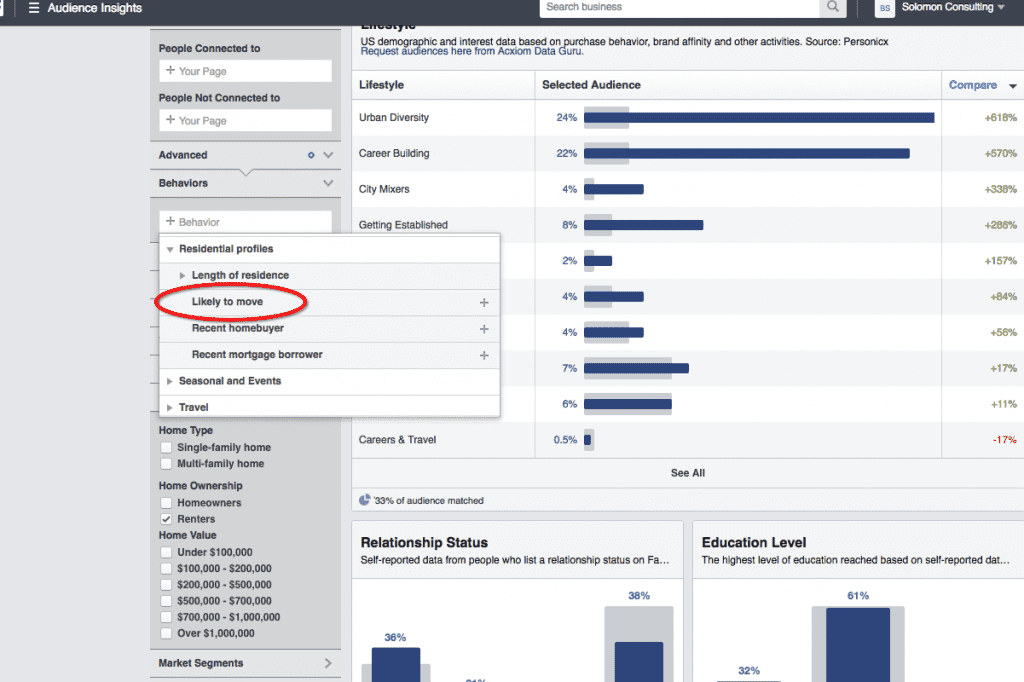
- People who have recently behaved in ways that make them great prospects for your offer. Are you a moving company trying to drum up business and get busy this summer? Offer $50 off the normal daily rate for customers in this audience:
OK, so I’ve put the offer on Facebook. What happens when someone clicks “Get Offer”?
Ah! Therein lies the beauty of “Facebook Offers!” The “click” triggers multiple events which remind your prospect that they took an interest in your offer.
- The click automatically takes the client to your landing page. The landing to which your traffic is sent should appropriately reflect the offer you’re advertising. Continuity and trust are so important in this process; having continuity and trust will help you generate the maximum number of conversions. The landing page should feature a form and a phone number. The form on the landing page should be straightforward and have as few fields as possible; generally speaking, the fewer the fields, the higher the likelihood of a lead. The phone number should be “clickable” and “textable.” You can also feature a video on your landing page, as well as pictures and testimonials. All of these elements should tie together to maximize your overall conversions.
- The click automatically prompts an e-mail to the prospect which includes links back to your offer.
- The click also “saves” the offer in the prospect’s “Saved Offers.”
- People will receive Facebook notifications and email notifications about your offer until it expires.
- Depending on their location settings, prospects can receive a notification about your offer when they are physically close to your business.
See how powerful this is? See why it’s better than a coupon?
Now, if your imagination is running wild with possibilities but you’re not sure how to get started or how to sort out which thing to offer first, let’s talk about it. Give us a call at 603-953-5212 or send us an email, and together we will formulate a winning strategy for you.